The addition of Texas and Oklahoma to the SEC will produce a football conference with a wealth of compelling in-conference matchups. And with a 12 team playoff beginning next season, out-of-conference scheduling will become much less important for SEC teams aspiring to the College Football Playoff (CFP). That’s the good news for SEC fans. The bad news is that designing an efficient, appealing conference structure is a difficult puzzle. The difficulty is due to the need to maintain equitable strengths of schedule, preserve traditional rivalries, and define a divisional structure that is meaningful to fans and minimizes schedule complexity.
So far, the only structure concept that has escaped the smoke-filled rooms of the conference office is an array of four-team pods (OK, not smoke-filled). This will work, but would have some disadvantages. First, this will force a conference championship game between the teams with the two best records. There will no longer be the prestige of a divisional championship, just two teams out of a sea of sixteen.
Another issue is the difficulty of avoiding differences in schedule strength between teams. Each team would presumably play the other three teams in their pod plus probably two standing rivalries each year. That leaves 10 other teams that would rotate through the schedule 3 at a time for an 8 game conference schedule or 4 at a time for a 9 team conference schedule, taking either 3 or 4 years to get through the entire conference. I think it would be difficult to select the pod members and the rivalries in such a way that did not result in a significant difference between the toughest and easiest schedules in any given year. And this structure might prove to be unwieldy when teams need to make shorter notice schedule changes.
One other result of the pod structure is the additional travel cost and time when 3 or 4 of the games are across the entire conference footprint rather than within the geographical footprint of the pod or rivalries. I am not saying this is unworkable or even necessarily bad. But there may be a much better way!
The Proposal
My proposal is simple. Keep the East and West divisional structure. Add Texas and Oklahoma to the SEC West. Move Missouri to the SEC West. Move Auburn and Alabama to the SEC East. Eliminate cross-division traditional rivalries (more on this later)! Go to a nine game SEC schedule, which would match the other power 5 conferences. This will preserve an exciting conference championship game with a lower probability of a rematch between the two divisional champs. It preserves the prestige of being a divisional champ, which is enhanced by even stronger 8 team divisions. I think this would also make it almost a slam dunk that the SEC would get at least two teams into the CFP most years. Here are the proposed divisions:
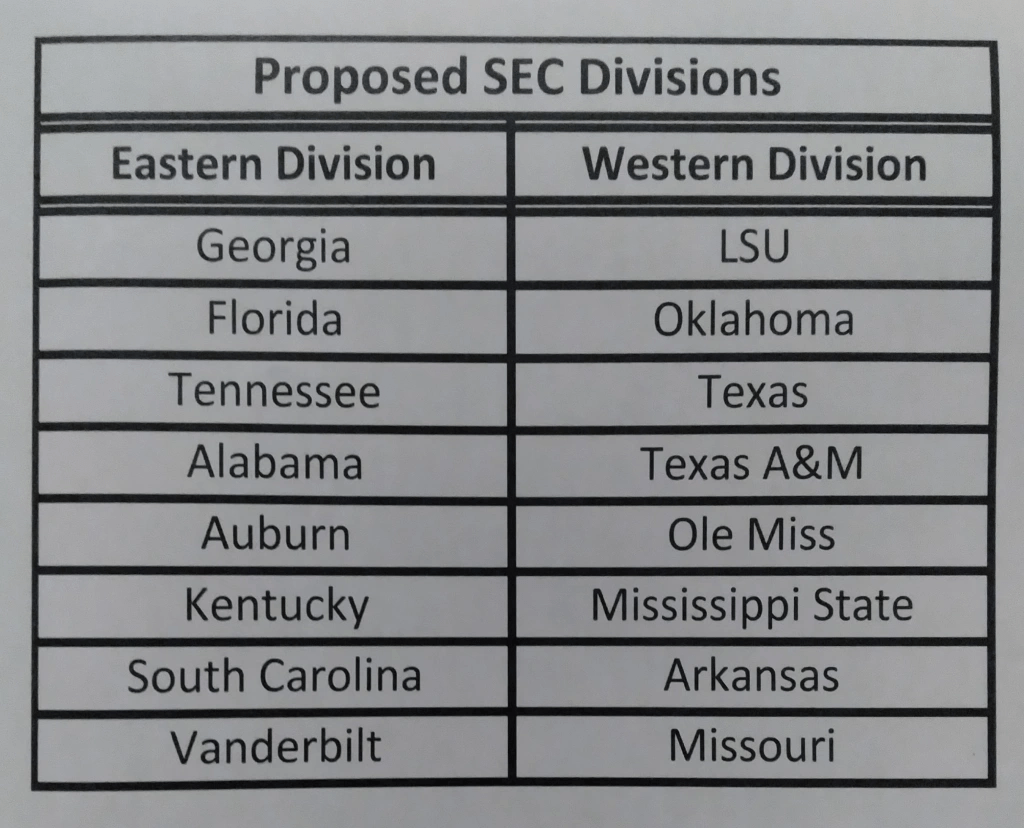
With this scheme, the team schedules would be simpler to construct. Each year, a team would play everyone in their division plus two teams from the other division, playing everyone in the other division every four years, repeating the same cross-divisional schedule in every four-year cycle!
With this scheme, each team would play 7 of their 9 conference games within the six contiguous state region of their division, saving travel costs and wear and tear on student athletes. And no, I’m not giving up on the concept of the student athlete, no matter how many sports writers line up behind the attempt to turn college football into NFL Lite.
Perhaps the best feature of this approach is that it preserves the most important traditional rivalries within the fixed structure of the divisions. Alabama-Auburn, Auburn-Georgia, Alabama-Tennessee, Georgia-Florida, Tennesse-Kentucky, LSU-Ole Miss, Ole Miss-Mississippi State, Texas-Texas A&M, Texas-Oklahoma, Arkansas-LSU, and all the rivalries from the old Southwestern and Big 12 Conferences (for teams now in the SEC) are all preserved. This allows a clean schedule without permanent cross-division rivalries as previously described.
Objections
There are always objections to any politically sensitive proposal. Some may say that there are a few important rivalries left out with this scheme. Another objection might be that the East would be too competitive compared to the West (which is the same thing people have said of the Western Division in the current configuration). But if you take a longer historical view of the various program traditions, I contend that this divisional scheme is very well balanced and respectful of the histories and traditions of the conference member institutions. And overall, I would hope this scheme could float up to some of the SEC power brokers and get serious consideration.
J D Harper
 Cogitation Stew